
Weld pass sequence: root, fill and cap passes
In a joint that is not filled in one go, metal is deposited in several passes (or beads). The order and location of each one is the pass sequence, and it is part of what a welding procedure must document.
Types of pass
- Root: the first pass, joining the parts at the bottom of the joint. Usually the most critical.
- Hot pass: in pipe, the second pass over the root, to fuse it and clear defects.
- Fill: the intermediate passes that fill the groove.
- Cap: the last layer, which defines the appearance and reinforcement of the weld.
Why the order matters
- Distortion and residual stress: always depositing on the same side warps the part; in double-sided joints the side is usually alternated to balance it.
- Heat input: the sequence and bead size determine how much heat the material receives, which affects microstructure and toughness.
- Fusion between beads: each pass must fuse well with the previous one and with the groove walls.
- Interpass temperature: controlling the interval between beads avoids overheating or cooling too much.
How to number and document them
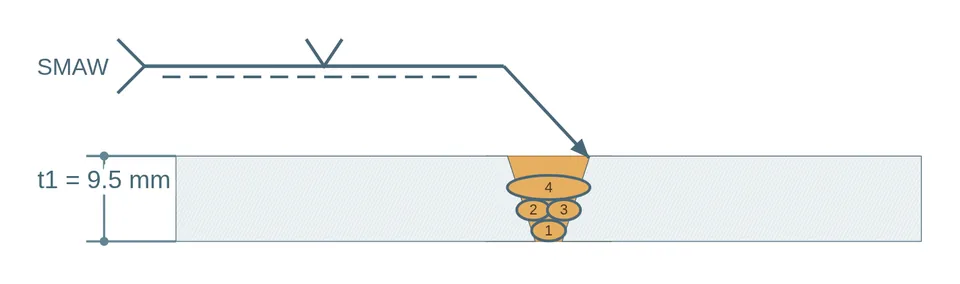
Draw the cross section of the joint and number each bead in the order it is deposited. Then tie each number to a row of the WPS parameters table:
| Pass | Process | Filler | Current | Voltage | Travel speed |
|---|---|---|---|---|---|
| 1 (root) | GTAW | ER70S-2 Ø2.4 mm | … | … | … |
| 2–3 (fill) | SMAW | E7018 Ø3.2 mm | … | … | … |
| 4 (cap) | SMAW | E7018 Ø4.0 mm | … | … | … |
Illustrative example table: actual consumables and parameters are defined by your procedure.
What matters is that every number in the drawing matches a row in the table. If the drawing shows four passes and the table three, the procedure is ambiguous.
Common techniques
- Stringer bead: no oscillation; lower heat input per pass.
- Weave bead: with side-to-side motion; covers more width, with more heat input.
- Back gouging: the root is removed from the other side before welding the second face.
- Travel direction: in pipe, whether uphill or downhill, and from which clock position.
Common mistakes
- Drawing a number of passes that does not match what will be made.
- Not saying which passes use which process or consumable.
- Not showing the direction or the order between sides in double-sided joints.
- Reusing the sequence of a different thickness without reviewing it.
Important: the final sequence is defined and validated by the welding engineer under the code and the procedure qualification.
Draw your joint in minutes
Pick from 166 geometries or 44 complete templates, adjust the dimensions and export PNG, SVG or PDF. Designing is free.